Case study: Showcasing National Museums Scotland's collections online
National Museums Scotland is a unique combination of collections, programmes, places, and people – who we've been working with since launching their website in 2024.
The website is a key tool in helping National Museums Scotland achieve their mission “to preserve, interpret and make accessible for all, the past and present of Scotland, other nations and cultures, and the natural world”.
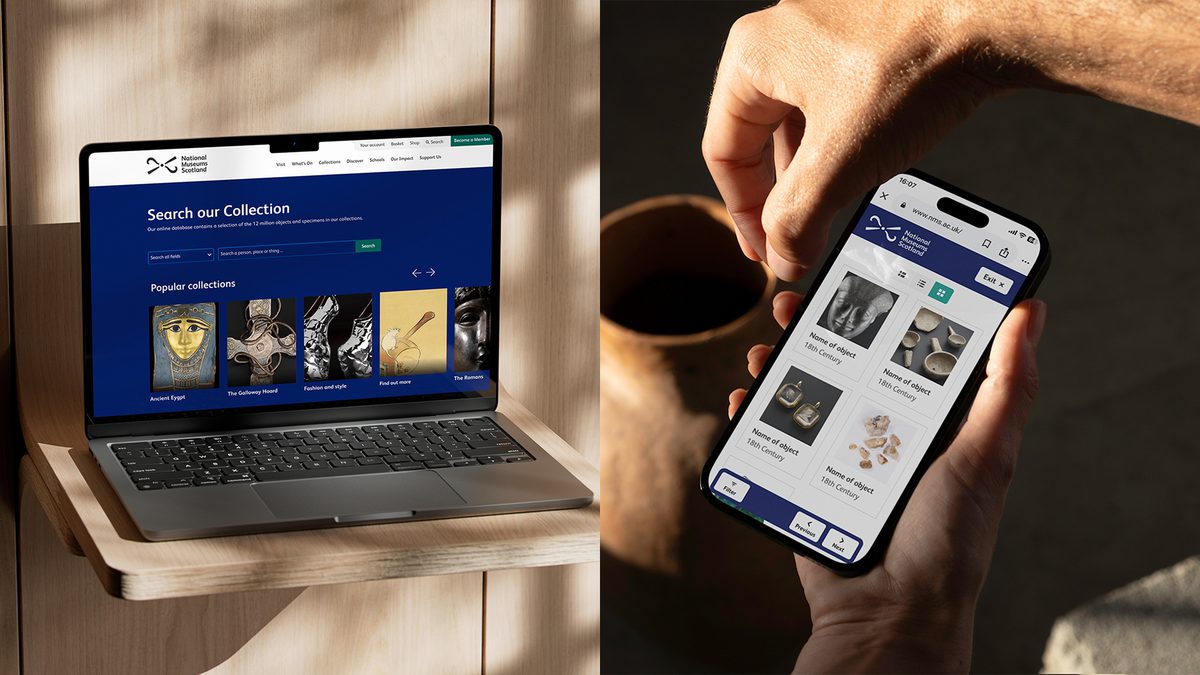
A vital part of any museum's online presence, a specific area of focus for us right from the start was how to showcase National Museums Scotland's collections.
The collections challenge
National Museums Scotland care for over 12 million objects across various collections. That’s a huge number of items, which could never all be physically on display at once. That’s where digital tech comes into its own.
We needed the website to showcase collections objects through an integration with Axiell Collections, a web-based collection management system. Axiel does a lot of the heavy-lifting in terms of storing and tagging collections data. We needed to make sure Axiell and the website worked well together, and that the website works for users.
Primary challenges for collections on the website:
- Technical – a smooth integration between Axiell and the website.
- User Experience (UX) – a user-friendly way to easily browse collections, and find specific objects.
That UX challenge is a biggie – because we need the website to work for people with hugely varying aims.
So, whether someone's a casual browser landing on the website through a social media post, or an academic researching Scottish-made jewellery from the Viking Age – they need to be able to search in a way that works for them, and get the results they need.
Remember, part of National Museums Scotland's mission is to be “accessible for all”.
Our approach
Iteration + collaboration
Although it can be tempting to change or 'fix' as much as possible during a new website project, there are benefits to creating an MVP (Minimum Viable Product), then planning-in incremental developments over time.
We agreed with the National Museums Scotland team to implement this MVP approach for their online collections integration. So we were able to concentrate on some of the biggest issues first. And, as always, we built their website to be flexible enough to support iterative improvements.
How did we know where to start with an MVP?
Before even starting on the new website project, National Museum Scotland had worked with the good people at One Further to review the existing collections search functionality, and how users were interacting with it.
So, we knew where there was most friction – so we knew which issues we should tackle first.
Then, over the following 12 months, we worked with the teams at National Museum Scotland and One Further to review the collections search function, so we knew where to focus our efforts to make meaningful changes – based on real-world user behaviours.
Supercool are always actively working with us to find the best solutions, and their communication is consistent, honest, and transparent. This took so much potential stress out of the trickier design challenges and technical hurdles that are inevitable in a big project.
Kate Amann – Digital Product Manager, National Museums Scotland
Our solution
How it started (the MVP)
One of the initial gnarly issues we tackled as part of the MVP was the design of search results.
One Further’s research found that, although people were using the Collections Search function, they were barely engaging with the results.
We deduced that the reason people weren't clicking search result links was because they thought the result was 'empty'. Not every collection item has an image, so there were a large number of 'placeholder' images appearing within search results.

You can see why users could be forgiven for thinking there was no information to display about a particular item!
So, we redesigned the search results list into 'cards'. Each card featuring a short description of the item, pulled from Axiell but also manually editable by the team. Plus a clear call to action to "View more details" – making it clear this is not a dead end:

How it's going
Over the following 12 months we developed the Collections Search, starting with some key goals:
- Allow for much more granular filtering
- Make the UX more intuitive for non-specialist users
- Meet users where they are – offer more options to view and engage with results
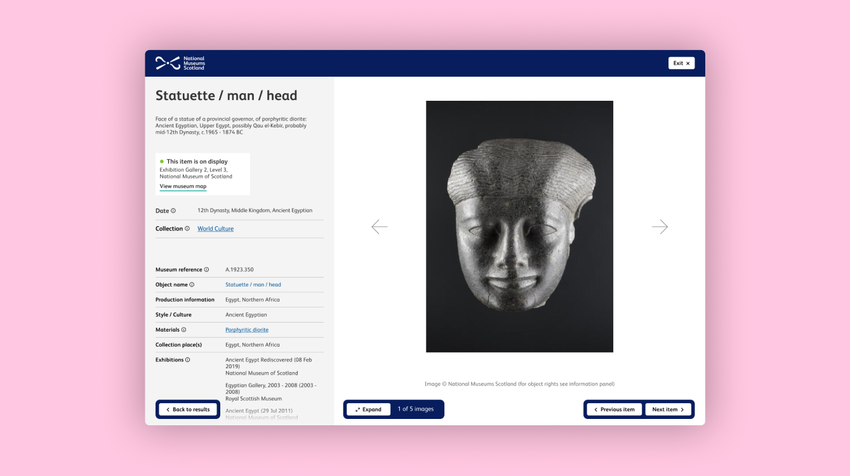
An 'app-inspired' design
With such granular filtering, we needed a way to show complex filtering options to users clearly. And with a broad user-base, the Collections Search needed to be easy to use and adapt to how users wanted to explore the collections.
An iterative design process resulted in this app-like design. We take users out of the core website design framework, into a dedicated space to explore collections. This helps users to undrstand they have lots of control – this isn't a regular website anymore!
Users are able to filter their results in a deceptively simple yet highly granular way. And even choose how those results are presented to them – either a General, Gallery, or List view.
Typically, once we have a design in place, any changes to it during the build phase tend to be very small – if any changes are even made at all.
But one of the biggest departures from our normal process was allowing time for more significant design changes during the website build. Because the Collections Search is so complex, we knew it would be difficult to stress-test designs robustly enough until we had real content in place, and could engage with the search tool in real time.
And we went through several iterations of design detail before landing on the current app-inspired design. This is why user testing – and allowing time for making tweaks based on the findings and feedback from that testing – is so important.
What’s next?
The current iteration of Collections Search offers all kinds of different users new and improved ways of exploring the Museum’s collections.
The team at National Museums Scotland will continue to run real-world user testing on this iteration, the results of which will inform any future developments and improvements.
Have a browse, and test it out for yourself:
National Museums Scotland – Collections Search
I have been really impressed with Supercool as developers and as partners. They are very easy to work with, and are also just lovely people.
Kate Amann – Digital Product Manager, National Museums Scotland